
Mapping the unknown: How Xcalibur is unlocking the resources that will define our future
Xcalibur Smart Mapping is the global leader in multi-source geodata integration, operating the world's largest airborne geophysics fleet across five continents. At the heart of its work is solving one urgent problem: the world's most consequential resource decisions are still being made with fragmented, incomplete data.
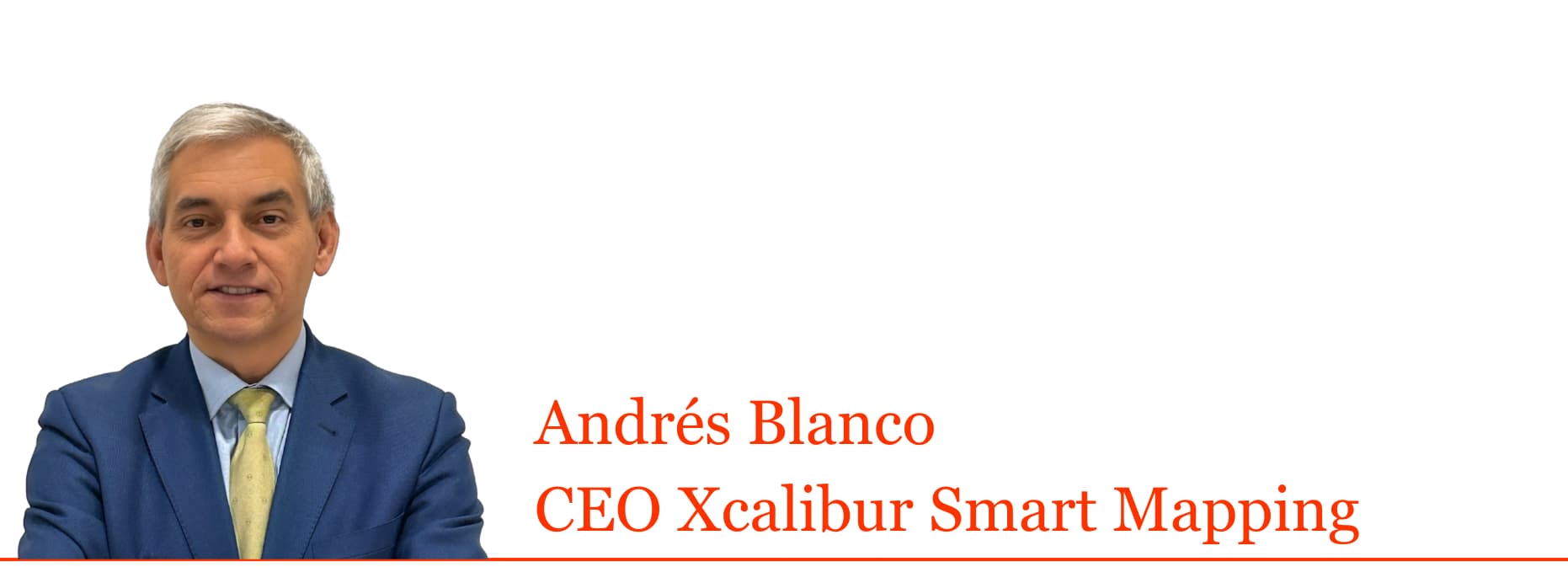
Ahead of the EIT RawMaterials Summit, we spoke with Andrés Blanco, CEO of Xcalibur Smart Mapping, to discuss Europe's critical raw materials ambition, how AI can help accelerate mineral exploration, and what that means for the race to secure Europe's future competitiveness.
EIT RawMaterials: For people unfamiliar with Xcalibur Smart Mapping, how would you describe what your company does?
Andrés Blanco: We work at the intersection of satellite technology, airborne geophysics, geological science and artificial intelligence. What we do, at its core, is take complex and fragmented geoscientific datasets and turn them into intelligence that governments, geological surveys and industry can actually act on. We call it Earth Intelligence.
We operate the world's largest airborne geophysics fleet, with more than 40 aircraft, and deliver national and regional mapping programmes across five continents. Our work supports more efficient exploration, resource planning and investment decisions across the critical raw materials value chain.
EIT RawMaterials: The platform through which you deliver these solutions is XENAI. How does it work, and how is it changing the way exploration and resource decisions get made?
Blanco: XENAI is our AI-driven Earth Intelligence platform. It integrates satellite imagery, airborne geophysics, geological surveys, climate models and socio-economic data into a single analytical framework, then applies machine learning to detect patterns, identify anomalies and generate predictive insights across both surface and subsurface environments. For mineral exploration and resource planning, that means real improvements in both speed and confidence.
EIT RawMaterials: Raw materials are critical for European competitiveness, and Europe has been clear about its ambitions under the Critical Raw Materials Act. From where you sit, what's the gap between policy and reality on the ground?
Blanco: The CRMA and the RESourceEU Action Plan represent a genuine political commitment to securing Europe's raw materials position. The targets are clear: 10% of Europe's annual consumption extracted domestically, 40% processed within Europe, 25% recycled, and critically, no single third country supplying more than 65% of any strategic raw material. That last benchmark is the most powerful and the most forgotten. It means Europe cannot afford the kind of dependency it has today on a handful of countries for specific raw materials. But there's a growing consensus forming among policymakers, industry, and technology leaders that the challenge now is building the intelligence infrastructure required to actually deliver it. You cannot execute a minerals strategy at scale without knowing, with precision, what's in the ground, where it is, and what it would cost to reach it. That is the phase that currently has no dedicated EU funding instrument. We call it the pre-competitive gap, and it is where Xcalibur Smart Mapping operates.
And the window to close it is narrowing. The Multiannual Financial Framework for 2028 to 2034 is entering its decisive phase right now. This is where Europe decides what it actually funds. If Earth Intelligence is not explicitly recognised and funded in that framework, Europe will struggle to turn the CRMA from policy into execution at scale. This is a once-in-a-generation budget cycle.
EIT RawMaterials: You're participating in a fireside chat at the Summit called "Built on Data: AI, Earth Intelligence and Europe's Economic Edge in Critical Raw Materials." What's the central argument you'll be making?
Blanco: Data is now a strategic asset in the same way that capital or geology is. Historically, the gap between surveying the ground and making an investment decision could be years. AI is collapsing that timeline. That speed and precision is an economic edge. The countries and companies that build that capability will move faster, explore smarter, and deploy capital more efficiently than those that do not. The Draghi Report identified precisely this kind of operational intelligence gap as one of the structural weaknesses in Europe's industrial competitiveness. We are here to close it.
EIT RawMaterials: What's next for Xcalibur?
Blanco: We are working on something exciting that we will announce on 21 May during the fireside chat at the EIT RawMaterials Summit. It will mark a meaningful moment for Europe's critical raw materials agenda. I encourage anyone working at the intersection of geoscience, policy and investment to join us there.
Andrés Blanco is CEO of Xcalibur Smart Mapping. Join him at the fireside chat — "Built on Data: AI, Earth Intelligence and Europe's Economic Edge in CRM" — 21 May, 14:30, EIT RawMaterials Summit 2026. Find out more here.
Learn more about Xcalibur Smart Mapping at xcaliburmp.com